Monday, June 14, 2021

Joseph Smith and Sidney Rigdon and their group of Saints travel the Missouri River by Canoe coloring page

 Welcome to my free coloring pages blog! 

There are over 1300 drawings to print and color for free!

Today's new drawing is of the Prophet Joseph Smith and Sidney Rigdon traveling by canoe. 


Joseph Smith and Sidney Rigdon in Canoe


For you members of The Church of Jesus Christ of Latter-Day Saints... this drawing was inspired by Doctrine and Covenants section 62.  The church at the time was divided geographically with many saints still in Kirtland, Ohio, and others in Missouri.  

Brother Joseph traveled with a group of men to have a conference in Missouri.  They traveled much of the way by boat or canoe.  In this drawing, Joseph and Sidney Rigdon are in their canoe.   Their canoe actually was tipped over by wind or waves and they nearly drowned.  However, their work on Earth clearly was not finished so they both survived the accident.  Back then many,,, in not most people did not know how to swim.  

I think Joseph Smith knew how to swim but Sidney Rigdon did not.  I am sure a whole legion of guardian angels were keeping watch over them.  

Section 62 of the Doctrine and Covenants tells how the Lord blesses those who bear testimony.  Their sins are forgiven.  Of course we are all sinners.  Only our Savior Jesus Christ was sin-free.  There are a lot of great things said in this section.  I especially like verse 47:  "He that is faithful and endureth shall overcome the world."  

NOTE:  This drawing, in printable form, can be found by clicking on the button labeled "Religious" and scrolling down to the bottom of the "Restoration" part of that list.  Have fun coloring.  


Saturday, June 12, 2021

Unicorn with other Unicorns and with other Magical Beings - Includes new Paint Unicorns coloring page

 Welcome to my blog of free coloring pages. 

There are over 1300 free coloring pages that you can print and color!

Today's new drawing is of a Mother Unicorn and her Foal with a Fairy. 


Unicorn Mother and Foal get an Apple from a Fairy Friend

(today's new drawing)

Unicorns are excellent parents.  Unicorns are NOT horned horses.  Unicorns are sentient beings with human intelligence.  They are often friendly with Fairies.  Unicorns can communicate telepathically with each other, with Fairies, /Dwarfs, Elves, etc. . . . . and with a few special mortals.  Regular animals (like squirrels) are less intelligent than Unicorns, however, Unicorns can still communicate with them. 

I should note that these two Unicorns are "Paint Unicorns."  Paint Unicorns are generally bicolored.  So color the spots a different color than the rest of the fur.  You could also choose a different color for the mane and tail.  If you want, you could color each spot a different color and make them "Rainbow Unicorns!"

NOTE:  This drawing can be found, in printable form, by clicking on the button labeled "Fantasy, Myths, and Circus."  Then scroll down to the bottom of the list.  The new drawings are always at the bottom of the lists.  Below are a few other pictures of a Unicorn with other Magical Beings.  In some cases, the other Magical Being is another Unicorn.  These older drawings will be found further up the printables list.  Have fun coloring!  


Unicorn Mare defending Foal


Unicorn Mommy and Foal


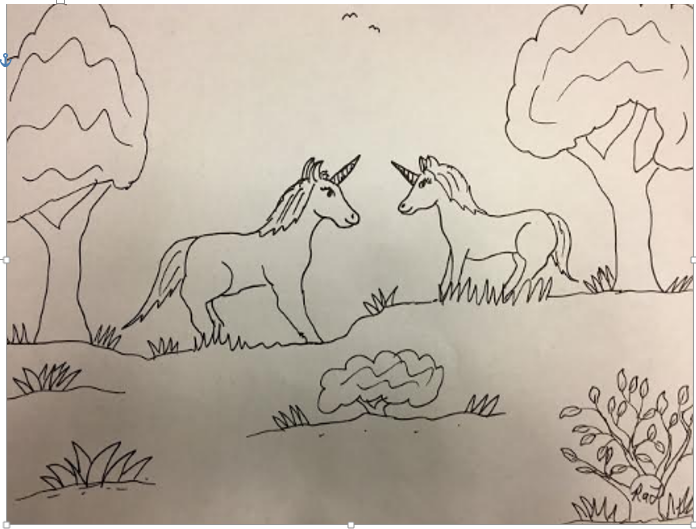
Unicorn Couple


Unicorn and Fairy Male are Friends


Fairy and a Unicorn


Unicorn and Mermaid


Unicorn and Friend Squirrel at Sunrise


Unicorn Filly with Fairy Friend finding Flowers


Unicorn with 2 Fairies


Unicorn with Dark Fairy


Unicorn with a Dwarf Friend

Wednesday, June 9, 2021

Nothronychus the very unusual Theropod Dinosaur coloring page

 This is a free coloring pages blog. 

Today's new drawing is of a very unusual dinosaur called Notheronychus.


Nothronychus the very unusual Theropod Dinosaur 


Nothronychus was a type of Therozinosaur.  It was very unusual in that it was a Theropod but ate plants.  The majority of Theropods ate meat or were carnivores.  But the Therozinosaurs all ate plants so they were herbivores.  

Nothronychus was a type of Therozinosaur first discovered in Western New Mexico on the Arizona border and then another species was discovered soon afterward in Southern Utah.  The Utah species was discovered where you mostly find marine reptiles.  It was within Utah's Grand Staircase Escalante National Monument.  It appears that the Nothronychus graffami must have been washed out to sea and fossilized in the seafloor sediment.   

The New Mexico species is called Nothronychus mckinleyi.  The two finds were definitely the same genus but they had enough differences to be the same species.  They were found around 200 miles apart and appeared to have lived between 1 million and 3 million years apart in the Cretaceous Period.  Both species were around 14 feet long or about 4 meters long.  They both weighed around 1800 lbs or about 800 kg.  

These dinosaurs looked like a partially plucked giant turkey.  They had a potbelly and had huge claws on very big arms.  Those claws were probably for defense.  Nothronychus had claws that were around 12 inches or 30 cm long.  The claws were backed up by very large arms.  It had small peg-like herbivore teeth, but its arms were probably very effective defensive weapons.  

There were also some Pterosaur fossilized bones that were found in the Grand Staircase Escalante National Monument so there are Pterosaurs in this drawing.  

NOTE:  This drawing, in printable form, can be found by clicking on the button labeled Paleontology and then scrolling down to the bottom of the Mesozoic section of the page.  Then click on the title of the drawing and you will have a printable page to color.  Have fun coloring!


Friday, June 4, 2021

Reef Mermaid with a Parrotfish coloring page

 This is a free coloring pages blog with hundreds of free drawings to print and color. 

Today's new drawing is of a Reef Mermaid who has a Parrotfish friend. 

NOTE:  Be advised that the below is a reworked drawing and is not the drawing I first posted.


Reef Mermaid Nikolosinia with a Parrotfish


Reef Mermaids live in and around coral reefs.  They are especially known to be friendly with local parrotfish.  The Reef Mermaids strive to protect the coral reef but with toxins from Man and global warming, there is no doubt that there is reef damage occurring.  

Many Mer-people have webbed hands, like Nikolosinia here.  She is swimming with her parrotfish friend,  You may have noticed different types of coral below her, including brain coral.  There is also a crab.  I may add to this drawing and repost it tomorrow.  

Parrotfish are amazing animals.  They are omnivores and there are around 80 species.  Some species of parrotfish eat coral.  They almost always eat only the dead part of the coral.  Then they excrete the ground up coral and it becomes those beautiful beaches many of us love.  So in other words, the and we love went through a parrotfish first.  The sand is basically parrotfish poop!  That is kind of funny if you think about it.  A single parrotfish can excrete up to 200 lbs or 90 kg of sand in a single year.  

The other fish in this drawing include the Lemon Shark.   (In the drawing the Lemon Shark is swimming away in the background after being driven off by Nikolosinia, the Mermaid.)  The other fish include the rather long and narrow Trumpetfish, the Bluestriped Grunt Fish, and the Banded Butterflyfish.  There is also an invertebrate... a squid.  All these species of ocean life are found in reefs off the coasts of North and South America as well as the Caribbean Sea.  

As far as the size of the fish in the drawing... the Lemon Shark can grow to just over 10 feet or 3 meters long.  (Remember that it is in the background swimming away so it looks shorter due to perspective.)  The Trumpetfish can grow up to a yard or just under a meter long. (THIS Trumpetfish is not that long.)  The Butterfly Fish are around 6 1/2 inches long at the most. The Bluestriped Grunt Fish can get to be up to 18 inches or 46 cm. long.   The Parrotfish can grow up to 1.2 meters long or about 4 feet long.  (This Parrotfish is not that long yet.)  

NOTE:  This drawing, in printable form, can be found by clicking on the button labeled "Animals" or "Fantasy, Myths, and Circus."  Then scroll down to the bottom of the list for the new drawing.  Have fun coloring.  

(one day later)

I reworked this drawing and added more reef species so I just posted the printable version.  It has more species and some minor errors in the drawing were corrected.    I also wanted to add that the Mermaid's name has some similarities to the scientific name of the Parrotfish.  

Kosmoceratops coloring page

Welcome to my free coloring pages blog.  Today's new drawing is of Kosmoceratops.


 Kosmoceratops Mother and Calf


Kosmoceratops was a Chasmosaruine type of Ceratopsian dinosaur that lived in the Cretaceous Period in what is now Southern Utah.  It was discovered in the Grand Staircase Escalante National Monument.  It is the most decorated of all the horned dinosaurs.  In fact, the Genus name of Kosmoceratops means "ornate horned face."  It had 15 total horns on its frill and face.  

It was about 15 feet or 4.5 meters long and weighed around 1.3 tons.  It was a herbivore and lived in what was at the time a much wetter place than Southern Utah is now.  It was wetlands and tropical forests and a nearby sea.  At the time North America was divided by an inland sea. 

This drawing is of a mother and her calf.  The calf in the foreground.  The calf is eating fern as the mother watches in the background of the drawing.  Note that there are several species of grass growing. Fairly recent discoveries show (via coprolite or fossilized feces) that herbivorous dinosaurs of the Cretaceous were eating 5 different species of grass before the meteorite put an end to all the fun.  

We recently made a trip to visit family in Kanab, Utah and we went over to see the visitor's center and museum at the Grand Staircase Escalante National Monument and saw the skull of this spectacular dinosaur.  I bought a toy version of the dinosaur. Today I drew it for you.  The toy is for my grandchildren but I DO have quite a collection of these high-quality dinosaurs and other prehistoric animal toys.  

NOTE:  This drawing, in printable form, can be found by clicking on the button labeled "Paleontology" and scrolling down the list to the end of the Mesozoic Era section.  Then click on the title and you'll get a printable coloring page.  


Tuesday, June 1, 2021

All About the Cougar - with coloring pages of Cougars & Prey Species

 Welcome to my free coloring pages blog!  

Today's new drawing is of a Cougar on a Fallen Tree. 


Cougar on a Fallen Tree


The cougar has many names.  Here are some of them...  Cougar, Puma, Mountain Lion, Devil Cat, Mountain Cat,  Ghost Cat, Mountain Screamer, Red Cat, Gato Monte, Panther, Catamount, Painter, Ghost Cat, Shadow Cat, Painter, Erielhonan, & Puma concolor.  Of course, the last names here are the Genus and species names or the scientific names.  The word "Cougar" seems to be of Native South American origin that was picked up and modified by the Portuguese.  

Erielhonan was the name the Erie Tribe of Native Americans had for the cougar.  It means "Long Tail." The Erie Nation considered themselves the Cat People. I guess Erie means "cat" or" long tail" in the Erie Tribe language.  But that tribe was all but wiped out by the Iroquois Nation in the 1600s.  The survivors were either adopted into one of the Iroquois tribes or were enslaved.  

Cougars are not considered one of the Big Cats because cougars can scream but they don't have a roar.  They DO have the ability to purr like your kitty that lives in your home.  They have a ridiculously high success rate in hunting.  They get 80% of the prey they stalk and ambush.  Or to put it another way they are successful in 80% of their hunts.  

Cougars are one of the most athletic of all animals.  Their back legs are longer than their front legs and that helps them to be able to leap great distances.  They can jump out of a tree branch that is 30 feet or 9 meters in the air and not get hurt.  A cougar can leap up onto a cliff or tree branch that is 18 feet high!  That is a high verticle leap!   Cougars are built more like a cross between a leopard and a cheetah than an African Lion. But they are more closely related to cheetahs than African Lions.  

Many Cougars live up in the mountains in the American West, but that is not why they got the name, "Mountain Lion."  There is a folk tale about this that may be based on truth:  

"In the early days of European settlers in North America, the Native Americans would bring pelts from cougars into New York City... or what would become NYC.  The Europeans and Africans thought these were female lion pelts and kept asking where the male lions with their manes were.  The Native Americans played a sort of joke by telling the Europeans and Africans that the male lions lived way up high in the mountains... hence the name Mountain Lion."  (Male cougars do not have a big fuzzy mane like the male African Lion.  The pelts the Native Americans were trading were from both male and female cougars or Mountain Lions...  So it is kind of funny I think.) 

Cougars are important to many Native American Tribes.  Some consider the cougar evil and yet many honor and revere the cougar in legends and totems etc.  

As far as size, a male cougar can be 5 feet or 1.5 meters long and that does not include the 3-foot or .91 meter tail.  The big males weigh up to 158 lbs. or 72 kg.  Although in 1901 a cougar was shot that weighed considerably more than 158 lbs.  It weighed 232 lbs or 118 kg.  There have been claims of even bigger sizes.  There is even a report of a large male cougar killed in Arizona that weighed around 300 lbs.  That is 136 kg. Of course, these really big male cougars are longer... possibly up to 9 feet or about 2.75 meters long... or longer.  These numbers are inconsistent because there are various data available about cougar size and it is not all identical.  

Cougars have a black spot on the end of their tail but not a tuft of hair like an African Lion.  The males can weigh up to 158 lbs.  The cougar is the biggest of the small cats.  It is related to the lynx and bobcat... but a cougar is much bigger than these smaller cats.  It is thought that the black spot on the end of the tail looks like a paintbrush and that may be the source of the name "Painters" for cougars. 

Several schools, colleges have the cougar or Puma as their mascot.  The university where I received my B.S. degree is the BYU Cougars.  Washington State University's mascot is also the Cougars.  There is a brand of clothing called Puma.  Puma is Cougar in Spanish but it is actually a word that came from the Incas. 

An interesting and rather humorous use of the word Cougar refers to a pretty but older female human who partners romantically with a younger man.  (My wife is one of those... although she hates for me to call her that. . . although I do in teasing once in a while.  In fact, in most people's opinion, my "Cougar" wife still looks 10 to 15 years younger than her actual age.  And we are both now considered Senior Citizens by most people's definition.) 

Although here in Utah, USA the cougars DO live up in the mountains, cougars live in many different habitats.  In Florida the Florida Panther subspecies lives in the swampy everglades.  There are cougars or pumas in the jungles of both Central America and South America.  They live in the Andes of South America and there is even a subspecies called the Andean Mountain Lion. Cougars also live in the deserts and plains of North and South America.  

In fact, Cougars have a range bigger than any other wild terrestrial or land animal in North America.  They live from Northern Canada and Northern Alaska clear down into Argentina, South America.  Cougars can bring down prey 3x their size... like a Mule Deer.  They are even known to bring down Elk and Moose, although bringing down such large armed prey is dangerous to a cougar.  Deer, Elk, and Moose antlers can do real damage.  A wounded cougar that can't hunt is a dead cougar.  

Cougars once roamed all over North America, but they are very rare in the Eastern parts of the USA due to man's encroachment and hunting.  The Florida subspecies of the Florida Panther is actually endangered.  They live mostly up in the mountains and other isolated areas of the Western USA, where we live. 

Cougars, the Puma concolor, not human cougars, live solitary lifestyles.  The males only meet up with the females for mating.  The females raise their litter of usually 2-4 cubs.  To be more precise, only the mother of the cubs raises the cubs.  Both males and females have a range they guard from other cougars.  

NOTE:  This new drawing up top can be found in printable form by clicking on the "Animals" button and scrolling down to the bottom of the list of animals.  Click on the title and you can print the picture to color.  Below are 2 other older drawings I have done of cougars.  They are from previous posts so they are further up the list of printable pages.  I also am including the model for this picture.  It was a taxidermy cougar on display at a sporting goods store.  Finally, I added a photo of one of the prey species of our local cougars... a mule deer.  I also learned that some cougars can kill and eat a porcupine, quills, and all. 


Cougar from Sportsman's Warehouse


Cougar on a Mountain Top


Cougar by a Pine Tree


These are prey species locally for our Utah Cougars.  Of course, a cougar would probably go after the old, sick, or young members of these deer family members because that would be a safer kill. 


Mule Deer Buck


Elk or Bull Elk


Moose or Bull Moose


Nasutoceratops in a Tropical Cretaceous Forest coloring pages

 Welcome to my free coloring pages blog.

Today's new drawing is from a horned dinosaur found in the Grand Staircase National Monument.

It is called Nasutoceratops! 


Nasutoceratops in a Tropical Cretaceous Forest

(New drawing)

Nasutoceratops is one of the many new discoveries in the Grand Staircase National Monument in Southern Utah.  We went there last week.  This was a very impressive animal.  It had horns that curved out like a modern bull.  It was one of the Ceratopsian or horned dinosaurs.  It lived in what back then was not a desert as it is now.  Back then, in the Cretaceous Period, this part of Utah was a tropical forest bordering an ocean.  It was more like Hawaii than Southern Utah is now.  

Nasutoceratops means Big Nosed Horned Face.  It had a particularly big nose or snout compared with most other Ceratopsian dinosaurs.  Nasutoceratops had no nose horn but it did have large brow horns that curved outward then pointed front... again... like a modern bovine bull.  (male cow)  Nasutoceratops was about 15 feet long or just over 4.5 meters long.  It weighed around 3400 lbs. or about 1.7 tons... or 1.5 metric tonnes.  The skull alone was 4.9 feet long or about 1.5 meters long.  So this was a big herbivore.  

It lived around 75 million years ago.  I will post later some photos from what it looks like now at the part of the world where this dinosaur lived.  It is a rather spectacular desert now.   The visitor's center at the monument has a great display of Nasutoceratops, Kosmosaurus, Diabloceratops, and Protoceratops skulls.  

The Pterosaur in this new drawing is of a yet-to-be-named species.  It DID exist in the same area and at the same time.  So far only the Pterosaur's ulna (forearm bone) has been found in the Grand Staircase National Monument.  But the size of the bone tells paleontologists that this flying reptile was quite large with a wingspan of around 4.5 meters or about 15 feet wide.  It may have been a type of Pteranodon or maybe more closely related to Cryodrakon.   

NOTE:  This drawing, in printable form, is found by clicking on the button labeled "Paleontology" then scroll down to the bottom of the Mesozoic Era list.   Click on the title and you get the printable version of the drawing.  Have fun coloring!   

FINAL NOTE:  I drew this dinosaur previously... but today's drawing is more detailed and actually a better drawing.  But below is the drawing from a previous post.  It is not quite as good, but it does show the curved shape of the horns better.  


Nasutoceratops

(Older drawing)