F-35 Lightning -Bomber Jet Aircraft
F-22 Raptor Stealth Fighter
F-35 Lightning -Bomber Jet Aircraft
I am continuing with our theme of bravery and being courageous... or our theme of
Profiles in Courage!
So, I present to you an American Badger up against a Grizzly Bear!
This is the new post today!
American Badger takes on a Sub-Adult Grizzly Bear
An American badger only grows to maybe 30 inches long and perhaps about a foot tall. They are brave mammals that will defend themselves against much larger predators. In this is drawing there is a sub-adult male Grizzly Bear that weighs around 500 lbs. The Grizzly Bear is wondering if the badger will be a good meal. The badger is bravely standing up to the bear and will not back down. The bear will soon decide that it would be best to find a safer prey.
This shows amazing courage. An adult badger weighs around 15 lbs. That makes the bear 33 times heavier than the badger. Yet if pressed or boxed in a badger will go on the attack to defend itself... even if the opponent is much larger. To me that makes the Badger the bravest of all animals that live here in North America.
Badgers live throughout North America.. especially in Western North America. They live in open land, forests, and even at very high elevations up to 12,000 feet.
NOTE: This drawing can be printed from this drawing on this page if you copy it and paste it into a word processing or drawing program. OR you can click on the Animals button and scroll down to the bottom. New drawings are on the bottom. This will be a printable page. Have fun coloring!
Welcome to my blog or welcome back to my blog!
I am continuing with the theme of "Profiles in Courage!
This is another drawing of a
Didelphodon. This time it is Didelphodon vs the rather large Dakotaraptor.
Dakotaraptor intimidated by a Courageous Didelphodon
In keeping up with the theme from my last post... I have drawn another depiction of courage. This is a Didelphodon again, but this time it is intimidating a far larger raptor dinosaur. The dinosaur is a Dakotaraptor. Both Didelphodon and Dakotaraptor lived in North America in the last part of the Cretaceous Period. Dakotaraptor was 15 feet or 5.5 meters long and was the biggest raptor of North America in the Late Cretaceous. Dakotaraptor may have weighed up to 772 lbs or a mass of 350 kg.
Didelphodon was an early mammal of the Late Cretaceous. It was a tough 1 foot or 0.3 meters long animal with an incredibly powerful bite force. It may have been much like a Honey Badger or a North American Badger and been able to defend itself against far larger animals. Didelphodon weighed 11 lbs. or had a mass of 5.5 kg.
NOTE: This drawing, along with all the paleontology drawings are found by clicking on the button labeled "Paleontology." Then scroll down to the bottom of the drop-down menu. Click on the title to get the printable drawing. OR you can click on the drawing on this page and copy it then paste it into a drawing or word processing program. Then print the picture from there.
Welcome to my free coloring pages blog.
I have not posted for a few days because I am recovering from surgery.
But here are my latest drawings. They are of a courageous early mammal
defending itself from a raptor dinosaur.
So these are the first drawings in a short series of drawings that I'm calling:
"Profiles in Courage!"
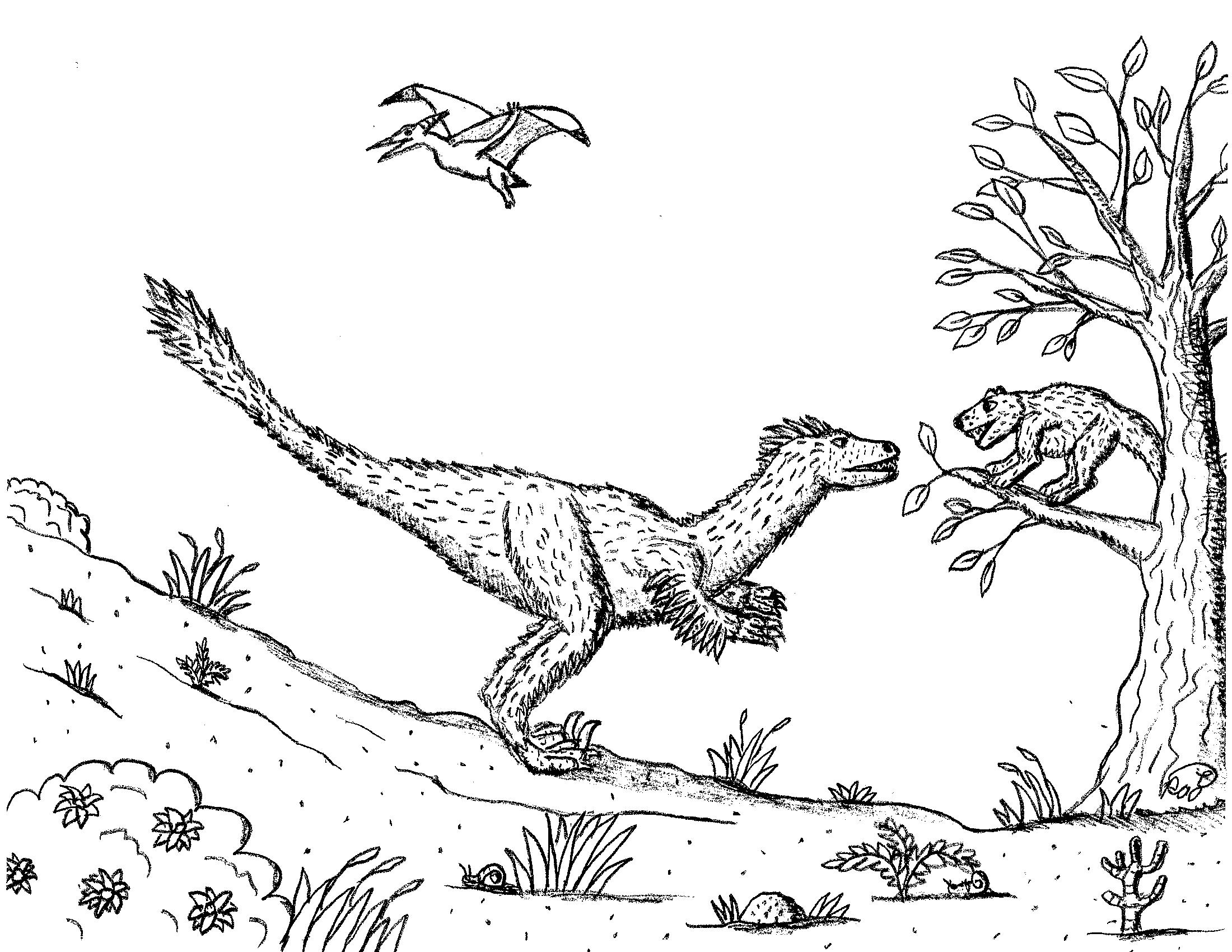
Courageous Didelphodon vs Raptor
Brave Didelphodon takes on a Troodon Raptor
My son wanted a drawing that shows courage. I immediately thought of Didelphodon. I expect that Didelphodon was as brave and courageous as a Honey Badger. Honey Badgers will face off against a lion. I will be drawing a Honey Badger soon.
Didelphodin was an early mammal who lived in the Cretaceous Period in North America. It was about 1 foot long and weighed about 11 lbs. making it one of the largest mammals of its time. That is 0.3 meters long and 5 kg in mass. Didelphodon vorax had canine teeth and was built stocky like a badger. It had an incredible bite force for a mammal its size. It had a powerful head and powerful jaws. It also seems to have been a pure predator with no ability to eat plant matter. It probably ate carrion and, smaller mammals, and could eat shelled creatures like snails and possibly clams and other shellfish and of course insects, spiders, & scorpions along with other hard-exoskeleton Arthropods. Didelphodon was a marsupial mammal and was similar to a modern possum, only with a more robust skull and much more powerful jaws.
I can easily picture this mammal dealing with raptor dinosaurs and it being successful at defending itself from them. This would take a tremendous amount of courage. Didelphodon could burrow and make dens as well. This made them able to survive the "end of the dinosaur world" meteor-caused extinction event.
Much evidence has been uncovered in the past several years on raptor dinosaurs. They may have all had feathers. There is some evidence that some raptor species had larger teeth as well. Raptors, like the Dromeosaurs, were among the most intelligent of dinosaurs. Troodon, as seen in the second drawing, was a Dromeosaur. It is thought to possibly the MOST intelligent of the dinosaurs.
The Pterosaur in the background is a Pteranodon. It was a common type of flying reptile of the Cretaceous Period. Pteranodons wingspread are known to have grown up to 8 feet or 26 meters. Many Pteranodon fossils have been found in land that was the bottom of the ocean, far from land, when the Pterosaur died. It is thought that they may have died during migration. Many of those fossils are found in Kansas, South Dakota, Wyoming, Alabama and other states in the USA.
If you are wondering about the grass, there is recent evidence that grass evolved and was eaten by dinosaurs of the Late Cretaceous. Paleontologists USED to think grass arose after the dinosaurs but grass seeds of 5 different species of grass was found in duck-bill or Hadrosaur dinosaur droppings. We call those fossilized feces coprolite. If you are wondering about the flowering plants or the flowers on the bushes, pollen has also been found that actually predates the dinosaurs. So we now know that dinosaurs lived with flowering plants that attracted insects AND with grass, which is a wind-pollinated flowering plant.
NOTE: These drawings, in printable form, are found by clicking on the button labeled "Paleontology" and scrolling down to the bottom of the Mesozoic section. It is also possible to print the picture by clicking on the drawing on this page and copying it. Then paste it into a drawing program or into a world processing program like Microsoft Word. Then you can resize it and print it.
This is my free coloring pages blog.
Today's new drawing is of a Spotted Unicorn with a Fairy.
Spotted Unicorn with Fairy
Fairies and Unicorns are often friendly to each other. In fact, many Fairies are best friends with a Unicorn. Therefore many Unicorns are best friends with a Fairy. The above Fairy is in her human size. She can, of course, shrink down magically to her natural Fairy size of about 5 inches tall. That is 12.7 cm.
Spotted Unicorns are unique in that they are particularly fond of the wide-open and often attach themselves to a herd of Wild Mustang horses. Of course, a spotted horse is called a "Paint." But a Unicorn is not a horse. Unicorns are sentient beings, like humans and Fairies.
NOTE: This drawing, in printable form, can be found by clicking on the button labeled "Fantasy, Myths, and Circus." Then scroll down to the bottom of the list. Older drawings may have an issue with needing permission to print but this new drawing will print fine. Also, I will post a few older drawings of Unicorns and Fairies down below this paragraph.
Welcome to my free coloring pages blog.
I posted this drawing with the words in English a few days ago.
I just realized that I should have posted
it in Hawaiian as well.
The English version can be found by scrolling
down past the next two dinosaur posts.
Mushroom Fairy from Hawaii named Neolani
Makemake nā Mushroom Fairies i ka ʻai ʻana i nā ʻōpū! Hoʻākoakoa lākou i ka ʻōpū a lawe i ko lākou kauhale i lalo e kaʻana. Nui nā ʻano ʻala a me nā mea ʻawaʻawa no laila ua hele ʻo Neolani i ke aʻo ʻana e hele wale i waho e hōʻiliʻili i ka ʻai a me ka ʻĀʻI i nā ʻōpala maikaʻi.
No Neolani mai a noho i Hawaiʻi. He nani ʻo ia ʻo Fairy a he akamai nō hoʻi ʻo ia. ʻO ka ʻoluʻolu ʻo ia kekahi. ʻO ia ka mea e hoʻolilo iā ia i ka ʻāpana holoʻokoʻa. Eia nō naʻe, e hoʻomanaʻo e loaʻa kekahi mau Dark Fairies e nani paha ke kino, akā ʻoi aku ka maikaʻi o ke ala inā ʻike ʻoe iā lākou.
ʻO Neolani kahi Manaʻo o ka mālamalama. ʻO kaʻoiaʻiʻo, ʻo kona inoa ʻo "He Mistly."
Aia he 400 mau ʻano like ʻole o ka ʻōpū ma Hawaiʻi a me 60 o kēlā mau ʻano he hopena i Hawaiʻi. ʻO ia ka mea i loaʻa iā lākou ma Hawaii ... a ma kahi ʻē aʻe o ka honua. Eia hou, ua hoʻoponopono ʻia kekahi a ua ʻona loa kekahi.
MAKUAKAHI # 1: E kiʻi i ka mana paʻi o kēia kiʻi kiʻekiʻe e hele wale i ka pihi i kapa ʻia ʻo Fantasy, Myths, a me Circus. A laila e hoʻokaʻawale i lalo o ka papa kuhikuhi i lalo. Eia nō hoʻi, hiki iā ʻoe ke kaomi ma ke kiʻi ma aneʻi ma kēia ʻaoʻao a kope i ke kiʻi a laila hoʻopili iā ia ma kahi huaʻōlelo a i ʻole ka hoʻolālā kiʻi ʻana a paʻi iā ia ma kēlā ʻano. Aia ma lalo iho nei kekahi mau Mushroom Fairies mai nā pou i hala.
MAKUAKAHI # 2: Ua nānā wale wau i kēia pou a ʻike wau ua hoʻouna wau iā ia ma Hawaiʻi a pēlā pū wau e hana nei i kēia manawa. Loaʻa ia ma Hawaiʻi ma kahi pou ma Mei 20, 2022.
Mushroom Fairy with Two Wands
English readers, the English version follows this post.
Early Tyrannosaur from Uzbekistan Timurlengia
Tirannosaurning O'zbekistondagi ilk Timurlengia
Tirannosaurning O'zbekistondan kelgan Timurlengia
Early Tyrannosaur from Uzbekistan Timurlengia without Feathers
Birinchidan, tuklari bo'lgan ko'plab Theropod dinozavrlari haqida kam munozaralar mavjud. Ba'zi paleontologlar HAMMA tirannozavrlarning tuklari bor deb o'ylashadi. Qanday bo'lmasin, bu erda ham tukli, ham tukli emas.
Timurlengia eutica nomli yangi tirannosaur O'zbekistonda topilgan. T. rex, Daspleteousaurus yoki Albertosaurusning ikki tirnoqli qo'llari o'rniga uch tirnoqli qo'llari bor edi. Bu yangi kashf etilgan Tirannosaur, Bo'r davrining oxirida, T. rex kabi edi.
Timurlengia keyinchalik Tirannosavrlarga qaraganda ancha kichik edi. Uning uzunligi taxminan 13 fut yoki uzunligi taxminan 4 metr edi. Uning vazni taxminan 600 funt yoki 270 kg edi. Bu eng qadimgi Tirannosaur emas, ammo uning kashfiyoti Tirannosaur evolyutsiyasida vaqt oralig'ini to'ldiradi. Bu shuni ko'rsatadiki, Tirannozavrlar kech bo'r davrida juda katta bo'lmagan. Timurlengia taxminan 90 million yil oldin, ayniqsa erta kech bo'rdoqi deb atalgan joyda yashagan. Bu juda rivojlangan sezgilarga ega edi, ular ulkan bo'lishidan oldin ham, ular juda nozik hid va eshitish hissi kabi ajoyib ov vositalariga ega bo'lishgan.
Izoh: Ushbu yangi rasm, chop etiladigan shaklda, yuqoridagi to'g'ri tugmachani bosish orqali topiladi. Keyin ushbu rasmni topish uchun Mezozoy bo'limining oxirgi qismiga o'ting. Shuningdek, ushbu rasmni blogning ushbu sahifasida bosishingiz va nusxalashingiz yoki saqlashingiz, keyin uni chizilgan yoki so'zlarni qayta ishlash dasturiga qo'yishingiz va o'sha erdan chop etishingiz mumkin. Shunday qilib, yorliqlangan tugmani bosing: Paleontologiya. (Paleontology)