Sunday, December 2, 2018

Can you hear your Ancestors?


Can you hear your Ancestors? 
(The young man or boy is too busy playing his video game to
 realize that his ancestors and trying to tell him to do his family history
 and get their names found AND get to the Temple for them.)

This is a post that will mean more to members of The Church of Jesus Christ of Latter Day
 Saints.  We believe in baptism for the dead.  This practice is mentioned in 1 Corinthians 
chapter 15. The Apostle  Paul is writing to people who were members of the Christian Church
 who seemed to have problems believing in the literal resurrection of the body.  So among
 his arguments in favor of the doctrine of resurrection he says:

            Else what shall they do who are baptized for the dead, if the dead rise not at all?
             why are they then baptized for the dead?  
                                                                         -1 Corinthians 15:29

So, the ancient church of Christ did baptisms for the dead.  This doctrine makes sense.  In means that even if someone missed the chance to hear the Gospel of Jesus Christ in mortality they can still hear it in the Spirit World and they can be baptized by proxy by a mortal.  

So we members of The Church of Jesus Christ of Latter Day Saints seek out family records and get the names of our relatives who have passed on.  Then we do the baptisms and other Temple ordinances  for them. . . including:  couples who were married for time only on Earth can be sealed by proxy.....and their children can be sealed to them as well.  So when they are resurrected they are a married couple for Time AND all Eternity.  We believe that when we die we go to the Spirit World, which is a temporary place until Christ returns and all the righteous spirits will be resurrected and return to Earth with Jesus in His Second Coming.  

So maybe, just maybe, your ancestors are trying to get through to you and telling you to get to work finding their names and get to the Temple to do their Temple work.  Our prophet, President Nelson, has told us members of the Church of Jesus Christ of Latter Day Saints to find ways to get to the Temple.  He also mentioned that we need to figure out what we can or need to give up so we can make it to the Temple more often.  


Saturday, December 1, 2018

Baryonyx Fishing

Baryonyx Fishing at a River
(new drawing)

Baryonyx was a Spinosaur that was first found in England in 1984.  It had a long snout and sensors on the end of that snout for detecting movement in murky water. .  The nostrils were up high so the dinosaur could dip its sensitive snout into the water to detect and catch fish.    Crocodiles and Alligators have the same type of sensors.  Baryonyx WAS a Spinosaur but did not have a sail like Spinosaurus.  It lived in the Early Cretaceous Period and perhaps was an ancestor to the much larger Spinosaurus.  Baryonyx was about 33 ft or 10 meters long and weighed close to 2 tons.  It probably ate fish when the fishing was good and ate other land animals when necessary.  

Baryonyx the Spinosaur
(This is an older drawing.)

Below are some older drawings of Spinosaurus.  Spinosaurs was 55 feet or about 17 meters long.  It also ate fish as a primary source of food.  It had the large sail that may have been for temperature regulation.  There were other species of Spinosaurs, such as Suchomimus, Ichthyovenator, Siamosaurus, etc.   

Spinosaurus Close Up


Spinosaurus after a Sawfish

Spinosaurus with Spots
This is not a bad drawing.  The back legs on Spinosaurtus were
 this short.  A newer discovery of a Spinosaurus 
skeleton in Moroccoshowed that this 55 foot long monster walked 
a bit like a Crocodile. . . and lived a lot like a croc. as well.  

Heleman and the Stripling Warriors

Heleman with a few of his Stripling Warriors
(New drawing)

In the Book of Mormon we learn about Heleman.  He was a prophet and leader of the Christian Church ...somewhere in the Americas ...about 62 B.C.    When the Nephite country was invaded Heleman took command of a bunch of young  volunteers called the Stripling Warriors.  These young soldiers had been Lamanites when they were very young.  Their parents converted to Christianity and many were killed and persecuted so they had to flee their homeland and live among their former enemies, the Nephites.  When they converted these former Lamanite men took an oath no never use weapons of war again.  But several years later they were about to repent of their oath because of all the suffering they saw among the Nephites . . . who had been invaded.  But in the end, instead of breaking their oath, the young men who were sons of those who took the no war oath... volunteered to fight and help defend their new country.  They were certainly all teenagers or maybe even pre-teens.  They fought with such courage that often the Lamanites fled before them.  They also fought with the strength of God.  They said that their mothers taught them to have faith.  In spite of fighting in many battles and all of them being wounded at one time or another. . . none of them ever died in battle or of battle wounds.  It is an amazing story found in the Book of Mormon in the book of Alma, chapters 56-58.

The big difference in these two drawings is the setting.  In the top drawing the Nephite Heleman and his Ammonite warriors are depicted in what would be similar to armor and fighting weaponry of the Mississippian or Mound Builder culture of North America near the Mississippi River.  The bottom picture. . . an older picture. . . is depicting Heleman and the Ammonite warriors in Central or South America.  The fact is, we do not know with certainty where the Book of Mormon events took place.  We members of The Church of Jesus Christ of Latter Day Saints believe the Book of Mormon to be a record of some of God's people somewhere in the Americas.  I actually studied the archaeology in Central America and Mexico when I was a college student.  I even lived in Mexico for a semester.  Many Latter Day Saints assume that the events of the Book of Mormon took place there in Middle America.  Others think it all happened in both North and South America.  The idea that perhaps it all took place near the Mississippi River is a relatively new theory.  

The weapons, shield, armor, and headdress in the first drawing up top are indicative of the Mississippian or Mound Builder culture.  They are not exactly like those found as relics, but they are similar.  The Mississippian Culture was quite advanced and it is amazing how little we know about them.  Many of their relics have been looted or destroyed over the years.  Of course the same might be said for the Mayan, Toltec, and Olmec cultures of Middle America. . . but we probably know more about them than we know about the Mound Builders or Mississippian Culture.  

NOTE:  Printable drawings are found by clicking the buttons up top.   The newer drawings are on the bottom of the correct list.  These drawings are both found under the All Printables button and the Religious button.  

Heleman leads the young Ammonite Warriors
  

Friday, November 30, 2018

Vixen the Reindeer


Vixen the Reindeer

Vixen is one of Santa's reindeer.  She is traditionally a female reindeer.  If you wonder why she has antlers if she's a female then you need to know than reindeer or  caribou are the only member of the deer family where both sexes have antlers.  This is a cartoon drawing so I did not draw the animal like a true reindeer.  In places in far north Asia and Europe the people have domesticated the caribou and that is called a reindeer.  In Europe and Asia the animals is generally called a reindeer and it is called a caribou in North America.  Since they live so far north the caribou are a circumpolar species.  There are several subspecies of reindeer or caribou and two subspecies have gone extinct.  There are millions of reindeer or caribou of some of the subspecies.  These animals include some that migrate and others that do not.   Of course some are domesticated and are thus tame.  That includes Santa's reindeer that have the additional very rare ability to fly.  This ability is attributes to the effect of the Aurora Borealis or Northern Lights and their intensity at the North Pole.  In the coloring page consider coloring in the Northern Lights.  Vixen is seen here checking out the North Pole.  Santa's castle can be seen in the background.   

To help you see what the Northern Lights look like I am including a photo taken of us and our tour group in Iceland last year at this time.  They are absolutely amazing to see in person.  I also saw the Aurora Borealis  the year I taught in Alaska.   


Northern Lights in Iceland November 2017


Northern Lights with Terrain Nov. 2017


Northern Lights with Town Nov. 2017
I loved the whirlpool look of this one. 

By the way, a vixen is a female fox so that is why Vixen the reindeer is considered to be female.  

Coral Pink Sand Dunes Common Grey Fox 
(Maybe she is a vixen  . . . This is a very different environment than the environment of reindeer.)

This is an older drawing so it will not be at the bottom of the Animals page or the All Printables page.  The drawing of Vixen the Reindeer is new so it will be at the bottom of the correct pages.  She can be found by clicking on the buttons labeled:  Holidays, Fantasy Myths and Circus, Animals, and All Printables.  Click on the button at the top of this blog page.  You will see the lists.  Just scroll down to find the pictures you want to print.  Again, the new drawings are at the bottom of the lists.

Put Me In The Zoo book review and coloring page

Put Me In The Zoo book cover

The book Put Me In The Zoo is a Beginner Books classic.  It was written and illustrated by Robert Lopshire and was first published before I was born.  It was published in 1960.  This book has fairly simple cartoon-like illustrations but they work for kids.  It has an animal named Spot that wants to live in the zoo.  Ok, he is not really named Spot in the book, but when my wife was reading the book to our daughter years ago she named him Spot.  So I shall call him Spot.  Anyway, Spot is not allowed to live in the zoo.  In fact, when Spot asks to live there the zookeepers carry him out . . . AKA throw him out of the zoo.  Then he meets what appears to be a brother and sister. . . two children and they ask him why he wants to live in the zoo and what can he do.  Then Spot proceeds to do amazing things with his spots.  He can change the spots' color, move his spots to other objects or even people, make them tall or small, make them fly, etc.  In the end he goes somewhere other than the zoo where he is very happy because it is a great fit for him.  Speaking as a former kindergarten and first grade teacher, I think these Beginner Books are excellent and they hold the kids' interest. d The words and sentences are readable by beginning readers.  By the way, I heard that Dr. Seuss edited this book.  

Spot plush or stuffed animal from Kohl's

I highly recommend this children's book.  It is my granddaughters favorite book for me to read to her.  Kohls, a department store, often has kid books and a plush to go with them.  We have purchased these for our grand-kids whenever we see them.  So today I sat with my grand-kids. . . there are two of them, and read the book while my granddaughter held "Spot,"  Afterwards I drew something that looks quite a lot like Spot.  This was for my granddaughter to color.  


Spot, from Put Me In The Zoo
You can color this with the spots all one color or use many different colors.  
The rest of Spot's fur is yellow.   Or do your picture any way you like.  

NOTE:  the printable version of the drawing of Spot is found by clicking one of the buttons up top.  It is a new drawing so it is at the bottom.  I decided to put the drawing under 3 buttons:  Animals,  Fantasy Myths and Circus, and All Printables.   Spot is on the Animal page because he IS an animal, although we are not sure what kind.  He is on the Fantasy Myths and Circus page because he (SPOILER ALERT) winds up living and happily performing at the circus. 

Thursday, November 29, 2018

Unicorns for young children to Color

Unicorn for young children to Color

This is a simple drawing for small children.  I drew it for my 3 year old granddaughter.  It is not too overly complex on purpose.  This is the only new drawing on this post.  
Unicorn and Squirrel friend hanging out
This is also a simple drawing for kids.  


Unicorn at sunrise by a River
(another fairly simple drawing for kids)


Unicorn mare defending Foal
(This one and the last drawing are more advanced drawing for older kids) 


Unicorn Traditional Look

Types of Dinosaurs worksheet

Dinosaur Types worksheet
(New Drawing)

I drew these dinosaurs a few weeks ago.  I decided tonight to make it into a worksheet.  The answers are as follows. . . I labeled the answers with where to find them on the worksheet. 


Triceratops Adult with forward facing Horns

Top left. . . Horned dinosaurs like Triceratops are Ceratropsians.  This includes Protoceratops that was an early Ceratosian with the hooked beak and frill. . . but no horns.  All Ceratopsians had a frill and the hooked beak.  Triceratops was the largest Ceratopsian at 30 feet or 9 meters long.


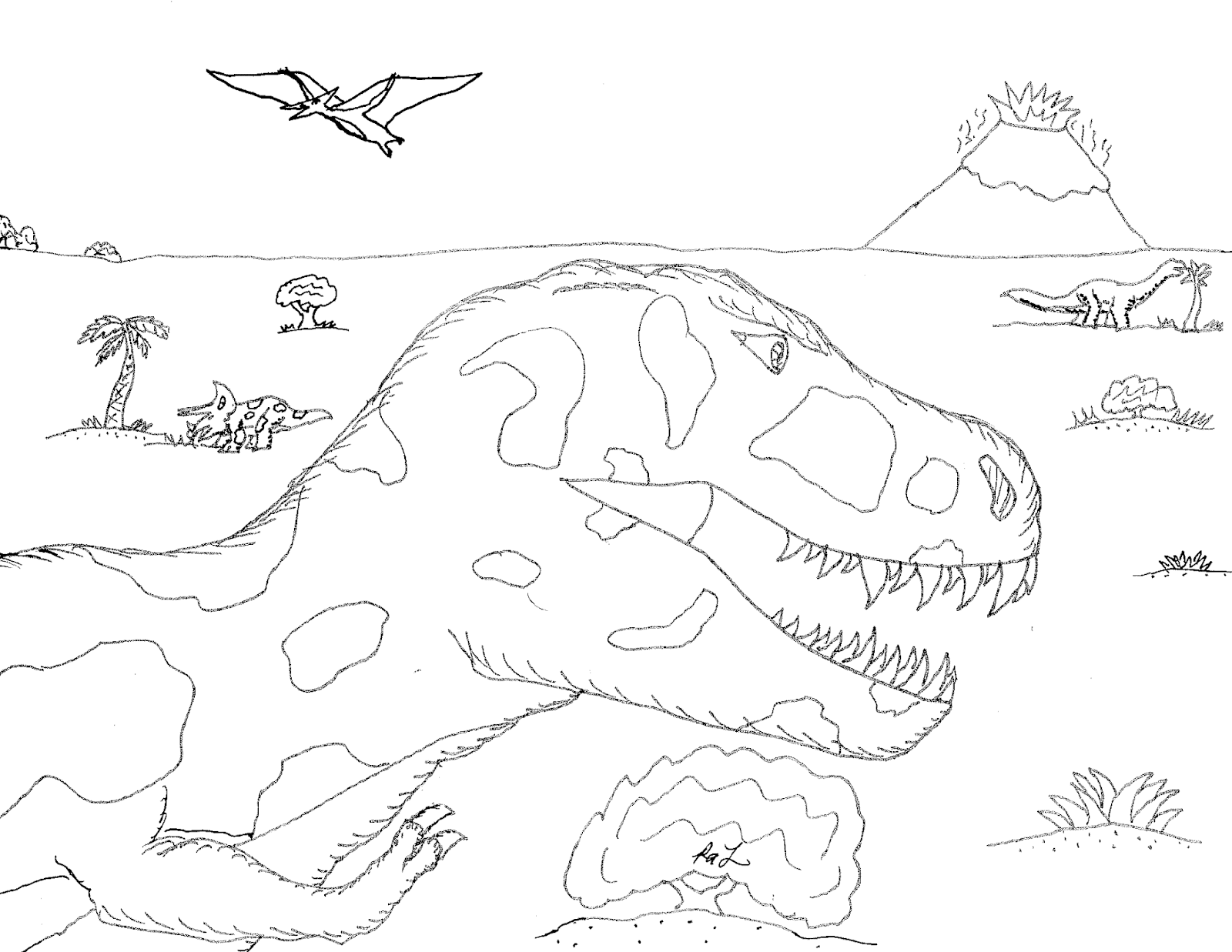
T. rex drawing from Skull

Top right. . . Meat eating dinosaurs like Tyrannosaurus rex are Theropods.  At least some of them had feathers and modern birds are considered Avian Theropod Dinosaurs.  Spinosaurus was the biggest Theropod at 55 feet or 17 meters long.


Ankylosaurus vs T. rex

Left side of page middle drawing. . . Ankylosaurus was an Armored dinosaur. . . this particular type is also an Ankylosaur.   There were several Ankylosaur species.   Some had a clubbed tail and some did not.


Stygomyloch and Dawn Draco

Right side of page middle drawing  . . .  Pachycephalosaurs were the "bonk heads" ...as my granddaughter calls them. . . and their 9 inch  or 23 cm thick skull was used as a weapon.   They were herbivores.  Some were 16 feet or 5 meters long.


Patagotitan the Biggest Dinosaur

Bottom left. . . The biggest dinos were the Sauropods.  They had tree trunk like legs and long necks and tails.  They were the biggest land animals ever to walk our planet.  They were herbivores.  Their long whip like tail may have been a defensive weapon.   Some Sauropods were 120 feet long.


Parasaurolophus Mates
(new drawing)

Bottom right. . . Duck bill dinos are called the Hadrosaurs.  Some had fancy crests on their heads.  Duckbill Dinosaurs probably could swim but they were land animals and seem to have even migrated. . . kind of like ducks. . . only by walking not flying.   Some were over 40 feet long.


NEW drawings like Parasaurolophus and the Dinosaur Types Worksheet are found at the bottom of the Paleontolgy list and the All Printables list.