Friday, May 3, 2024

Sea Turtle Hatchlings swimming in the Ocean cartoon coloring page

Now here is another drawing from my Reptiles post. 

This is of a few Sea Turtle Hatchlings swimming in the sea. 


Sea Turtle Hatchlings cartoon drawing 

This is a cartoon drawing of sea turtles.  Sea Turtles crawl onto land to lay their eggs in the sand of sandy beaches.  Then the mother books it back into the ocean.  Her eggs hatch and the baby sea turtles (hatchlings) book it to the ocean too.  About one in 100 sea turtles live to reproduce.  In this drawing the sea turtles are clearly hatchlings that DID make it to the ocean.  Some of the turtle hatchlings are farther away so they are drawn smaller.  In cartoons, eyelashes make the animal a female. 

This drawing, in printable form, is found by clicking on the button labeled Animals.  Scroll down to near the bottom to see the title and then click on it to get your printable coloring page.  Have fun!


Long-necked Galapagos Tortiose with Frigate Bird coloring page

You have found my free coloring pages blog.

 Here is another reptile drawing from my Reptiles post.  It is a drawing of a long-necked 

Galapagos Tortoise.  It also includes a Frigate Bird.


Long-Necked Galapagos Tortoise

There are several species of Galapagos tortoise.  One species evolved a long neck to be able to reach cactus from cactus trees.  This drawing is of one of those.  The Galapagos tortoises are the largest species of tortoise in the world.  Be aware that there ARE bigger sea turtles, but a turtle is aquatic while a tortoise is terrestrial.  In fact, a tortoise can't swim so if you put it in the water it will drown.  This long-necked Galapagos tortoise evolved from a common ancestor of the Galapagos tortoise that has shorter necks.  But natural selection in action led to these long-necked tortoises getting longer necks so they could reach cacti from cactus trees.  The drawing has a cactus but not a big cactus tree. 

Frigate Birds look like a Pterasoar when they are flying.  They are black sea birds but the males have a large red gular pouch that they inflate to attract females of the species. 

This drawing, in printable form, is found by clicking on the Animals button and scrolling to the bottom of the list of drawings.  Have fun coloring this Galapagos tortoise!


Triceratops Drawings coloring pages

 This is my free coloring pages blog.  This first drawing was posted as part of my Reptiles post 

a few days ago.  The second is a newer drawing of Triceratops that I just finished drawing today. 


Triceratops ignoring Volcano

Triceratops was a large quadrupedal herbivore.  Although considered part of Dinosauria, it is also still considered to possibly have still been a large reptile. It was around 30 feet or 9 meters long and had brow horns the length of broomsticks. These large horns may have been for sexual display, but considering the top predator in North America at the time, those horns were also clearly for defense.  Parallel evolution is when two animals with a relationship evolve together.  In predator-prey relationships, it is thought that size can be involved.  The mammals of the Mesozoic did not evolve into larger animals because they had to be able to burrow and hide from all the dinosaurian predators.  In the case of Triceratops and T. rex, the dinosaurs were hunted and hunter.  AKA predator-prey.  So as the Tyrannosaurs evolved into bigger size the Ceratopsians evolved bigger size and bigger defenses.  Those three horns, especially the brow horns, were evolved defenses.  The frill was also probably part of that defense.  Although considering the strength of T. rex's bite the frill would not be great protection.  But getting stabbed in the gut or in the leg even would have done a number on a predator.  If injured it could not hunt and thus would certainly starve to death unless fed by another member of the pack. 


Triceratops horridus Mother and Calf

Triceratops is the Genus and horridus is the species.  But the odds are that Triceratops horridus was NOT a horrid mother.  In fact, the Ceratopsians clearly lived in herds and almost certainly protected the young - probably by surrounding them like modern bison do  This drawing is the new one in this post. The young of Triceratops or of many of the non-Theropod dinosaurs are called calf or calves. 

To get to the printable version of these Triceratops drawings just click on the button labeled "Paleontology" and scroll down to near the bottom part of the "Mesozoic" section.  Have fun coloring Triceratops! And you can choose the color(s) for the spots etc. 


Baryonyx, two Marine Reptiles, and a Sauropod coloring page

This is another one of the Reptile drawings that I posted previously but I 

am now posting it individually.   Being an enthusiast of Paleontology, Geology, Biology, etc. 

I wrote about the animals in the drawing.  Of course, I drew the picture as well. 

 In fact, I drew nearly all the drawings on this free coloring pages blog... 

all except a few done by a grandniece and a grandnephew. 

In fact, I always write about each of my drawings that I post on this free coloring pages blog. 


Baryonyx near Two Marine Reptiles

A somewhat different version of this drawing was posted previously.  I have included two marine reptiles in this new version of this drawing.  One is an Ichthyosaur and the other is a long-neck Plesiosaur.  They are in an estuary - that is, brackish water near the mouth of a river... where it runs into the ocean.  There IS some evidence of some Mesozoic marine reptiles living in estuaries.  Baryonyx was a type of Spinosaur.  It actually mostly fed on fish.  This is a mother Baryonyx who is carrying her offspring in her mouth, like modern crocodilians do.  I suppose that Baryonyx might have also fed on small marine reptiles if they got close enough.  Or maybe Baryonyx could swim out into the river to catch small or young marine reptiles.  But its main diet was probably river fish.  By the way, there is a Sauropod and two Pteranodon Pterosaurs in the distance. Baryonyx was an early Spinosaur.  It did not have a sail like Spinosaurs. And Baryonyx lived during the EARLY Cretaceous Periond in what is now North America and Spinosaurus lived in the LATE Cretaceous millions of years after Baryonyx.  Plus Spinosaurus lived in what is now North Africa. So they are somewhat related.  They had a common ancestor. Both ate fish.

This drawing, in printable form, is found by clicking on the Paleontology button and scrolling down to near the bottom of the Mesozoic part of the list.  Have fun coloring!


Jurassic and Cretaceous Period Marine Reptiles coloring pages

These are two of the previously posted drawings from my set of Reptile drawings.  I decided to post these two drawings together.  The second is from the Jurassic Period.  The first is from the Cretaceous Period.  The Cretaceous Period came AFTER the Jurassic.   One big difference in the oceans of the two geologic periods was that in the Jurassic the Pliosaurs were the top marine predators.  In the Cretaceous, it was the Mosaurs who ruled the seas. 


Mosasaur hunting Plesiosaur

This is a drawing of the Cretaceous Sea.  It includes a Mosasaur and a Plesiosaur.  Plesiosaurs were long-neck marine reptiles.  Previously it was thought that Mosasaurs had a a long flat tail.  Now tail flukes have been found on some Mosasaurs so possibly all of them had tail flukes or tail fins.  This is a smaller - possibly subadult Mosasaur hunting a Plesiosaur.  There are a few other animals in the drawing, like the shelled floating Ammonites on the lower left and a crab near the lower right.  These animals were all living in the Late Cretaceous Period.  Plesiosaurs actually also lived in the Jurassic Period.  As far as size, the Mosasaurs could get to be 55 feet long.  Some Plesiosaurs could get to the length of 50 feet, with much of that length made up of their long skinny neck.  FYI some Plesiosaurs (called Pliosaurs) had short necks and they were the kings of the sea in the Jurassic Period.  Remember that THIS is a drawing of the Cretaceous Sea, not the Jurassic Ocean.  


Pliosaur hunts an Ichthyosaur

Pliosaurs are short-necked Plesiosaurs.  One of the more well-known ones is Liopleurodon. It is seen here about to attack an Ichthyosaur.  Opthalmosaurus was an Ichthyosaur with large eyes for seeing in deep and dark water.  The Opthanlmosaurs is about to bite into its favorite prey, an Ammonite.  But the poor Opthalmosaurus is not aware that it is about to become lunch for the Liopleurodon.  To be clear, Liopleurodon was a short-necked Plesiosaur called a Pliosuar.  Opthalmosaurus was a type of Ichthyosaur.  It was considerably smaller than the Ichthyotitan that is further up this post.  Opthalmosaurus was around 20 feet (6 meters) long and marine reptiles from the Liopleurodon genus were somewhere between 16 and 85 feet (5-25 meters) long.  

To find these drawing in printable form just click on the button labeled Paleontology and then scroll down to near the bottom of the Mesozoic Life section of the page.  Have fun coloring!


Ichtyotitan the Biggest Ichthyosaur and the Biggest Marine Reptile coloring page

  This is one of the Reptile drawings I posted previously.

I am now posting each drawing individually. 

This is my free coloring pages blog... with around 3000 coloring pages that I have drawn.

I am a retired science teacher and a confirmed Paleontology and Biology fanatic...

 so I will tell you about the animals in each drawing.

I should add that I am a Geology enthusiast as well.


Ichthyotitan the Biggest Marine Reptile

The first found fossils of Ichthyotitan were found a few years ago by an 11-year-old girl.  
The fossils were found near the same place as Mary Anning found the first known Ichthyosaur.  The 11-year-old girl is named Ruby Reynolds.  The fossils of Ichthyotitan were enormous.  They turned out to be a few of the bones of quite possibly the biggest marine reptile ever.  Icthyotitan was an Ichthyosaur.  It was shaped vaguely like a dolphin... only a HUGE dolphin!  It is estimated to have been 82 feet long!  That is 25 meters long!  There IS some evidence of a larger Ichthyosaur but there is speculation that it may be another sample of Ichthyotitan.  

Other similar gigantic Ichthyosaurs were found deep in the Southern Nevada desert and that spot is now a state park.  It is called Berlin Ichthyosaur State Park.  My wife and I have been there.  It is amazing to see the fossilized bones of such huge marine animals!

The two Pterosaurs that are seen in the sky are Rhamphorhynchus and Caelestiventus. They are both Pterosaurs from the late Triassic Period, so they did live at the same time as Ichthyotitan.  To get to the printable version of this drawing just click on the Paleontology button and scroll down to the bottom of the Mesozoic section of the list.  Click on the title and print.  Have fun coloring!


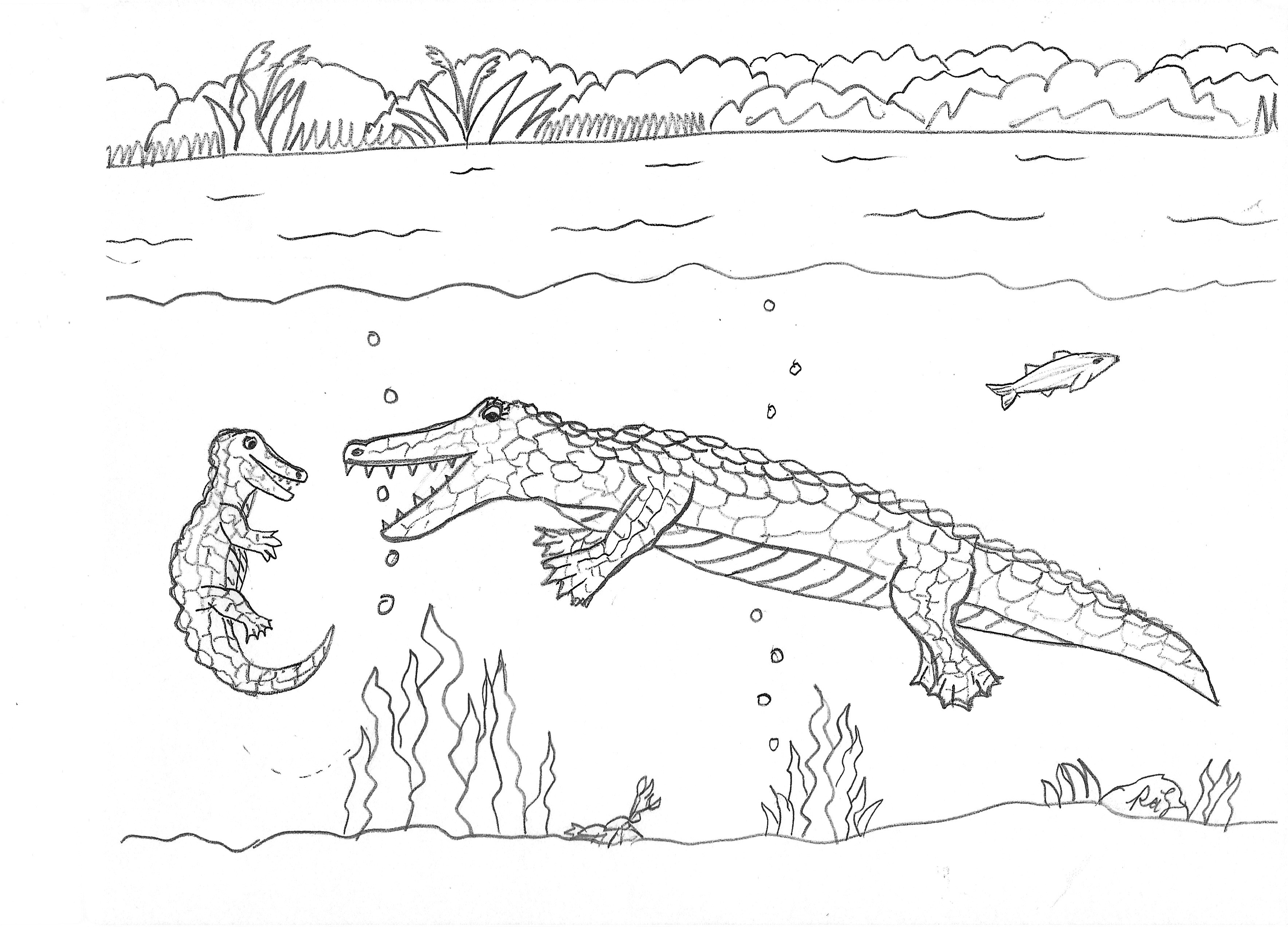
Crocodile Mommy and Son coloring page


 This is one of the Reptile drawings I posted previously.

I am now posting each drawing individually. 

This is my free coloring pages blog... with around 3000 coloring pages that I have drawn.

I am a retired science teacher and a confirmed paleontology and biology fanatic...

 so I will tell you about the animals in each drawing.


Crocodile Mommy and Son 

Crocodilians have been around for a long time here on Earth.  They lived before the dinosaurs, with the dinosaurs they got huge, and even now they (crocodilians) are thriving on Earth.  Since this is a cartoon drawing you can change it from Crocodile Mommy and Son to Crocodile Mommy and Daughter.  Just add eyelashes to the juvenile in the cartoon drawing and that makes the animal a female... AKA a daughter.   The crocodilians include caiman, alligators, and crocodiles.

To get to the printable version of this page just click on the Animals button and scroll to the bottom of the list. Then click on the title to get this drawing to print and color. Have fun coloring!